
MariBank vs Hanshan: Which Offers a Better SGD to RMB Exchange Rate?
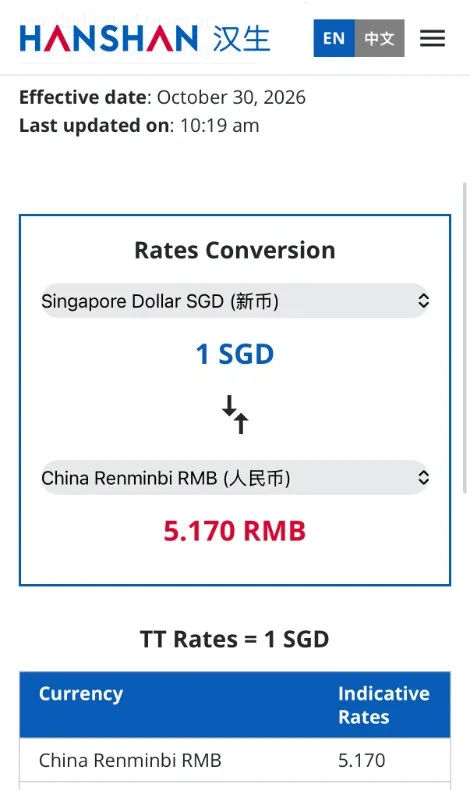
Both numbers below are from the morning of 30 Oct 2026. MariBank is the in-app Alipay quote at 10:25am: 1 SGD = 5.1920119 CNY. Hanshan is the indicative telegraphic-transfer rate on hanshanmoney.com at 10:19am: 1 SGD = 5.170 RMB. I am comparing them on S$1,000with the fee at zero, because the MariBank screen marked the Alipay fee as free and Hanshan's rate page did not show a fee. One Alipay or Weixin Pay transfer is capped at CNY 50,000, so this example stays inside a single transfer.
Reference rates captured 30 Oct 2026, not live
| At S$1,000 | MariBank | Hanshan |
|---|---|---|
| Rate | 5.1920119 | 5.170 |
| RMB received | RMB 5,192.01 | RMB 5,170.00 |
| RMB difference | MariBank pays RMB 22.01 more | |
| SGD equivalent | About S$4.24 at the MariBank rate (RMB difference ÷ 5.1920119) | |
On this snapshot MariBank was ahead. That does not make it the rate you will get next week, and it does not mean I sent Jishang through MariBank. Hanshan is the rate I used. Put your own amount in the calculator if the bill is not S$1,000, or if a fee comes back. A single Alipay or Weixin Pay transfer still cannot exceed CNY 50,000.
MariBank referral code
This is my referral code.
MariBank's personal banking referral page, which I checked on 30 Oct 2026, says a referrer earns up to S$15 cash for each friend who successfully signs up with their code. A new customer gets S$8 cash for a Mari Savings Account or Mari Invest Bundle, or S$15 cash for a Mari Credit Card Bundle or Instant Loan Bundle. The promotion runs from 1 October until 31 October 2026 and is limited to the first 10,000 successful referrals. It is subject to MariBank's Refer & Get Rewarded (Oct 2026) terms.
You enter the code in the MariBank app when you apply. Details are on their referral help article and refer-a-friend page.
See MariBank's referral programmeSGD to RMB calculator
It opens on S$1,000 so the example stays inside the CNY 50,000 per-transfer cap on Alipay and Weixin Pay. The two starting rates are the 30 Oct 2026 captures. Edit them, add a third provider, or type a fee if the app stops showing the transfer as free. Results update as you type. Larger presets are a whole bill — split anything that would land above CNY 50,000 in one transfer.
Why Your SGD to RMB Exchange Rate Matters When Paying for China Carpentry
A China carpentry bill is not one small transfer. It might be a kitchen, a run of wardrobes, a TV wall, custom furniture, or the full house. My own carpentry invoice to Jishang was $15,538, which I wrote up in the China carpentry Singapore post. I converted that one on the Hanshan rate. The contractors I actually use are on the contractors page.
The gap is boring until you scale it. Ten cents of rate, on every Singapore dollar, is RMB 500 per S$5,000. A fee of a few dollars barely shows up next to that. The table below is illustrative. It uses 5.20 and 5.10 so you can see the shape of the gap. It is not the MariBank quote and it is not the Hanshan quote from 30 Oct.
| You send | At 5.20 | At 5.10 | Difference |
|---|---|---|---|
| S$5,000.00 | RMB 26,000.00 | RMB 25,500.00 | RMB 500.00 |
| S$10,000.00 | RMB 52,000.00 | RMB 51,000.00 | RMB 1,000.00 |
| S$20,000.00 | RMB 104,000.00 | RMB 102,000.00 | RMB 2,000.00 |
| S$30,000.00 | RMB 156,000.00 | RMB 153,000.00 | RMB 3,000.00 |
Illustrative. Not a live rate, and not the 30 Oct 2026 MariBank or Hanshan capture. One Alipay or Weixin Pay transfer is capped at CNY 50,000, so the S$5,000 row can be one transfer and the larger rows are a whole bill you would split.
Is MariBank Good for SGD to RMB Conversion?
The rate in the app is the provider's rate. Their margin against the market is already inside it. I do not have a separate interbank print for 30 Oct 2026, so I am not going to invent a “real” mid-market number and call the gap a spread. The check I can actually do is simpler: same morning, same SGD amount, how much RMB does each provider put on the other side. On 30 Oct, MariBank's Alipay quote beat Hanshan's indicative TT rate. That is the comparison. It is not a ranking of every app in Singapore.
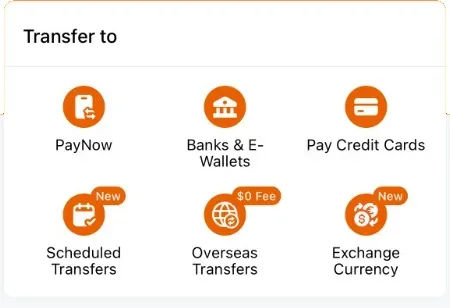
How I check it: open the app, get to Overseas Transfers, set China, and read the rate on the amount screen before Get Started. MariBank documents the product on their overseas transfer page, the how to send money to Mainland China article, and the transfer method guide. The in-app number is the one that matters. This article is a snapshot.
Fees
The screen I captured said $0 Transfer Fee, and it struck through SGD 6.00 on the Alipay method and marked it FREE. MariBank's fees page still lists the standard China CNY fees: S$6.00 for Alipay, S$5.00 for Weixin Pay, and S$3.00 plus 0.60% of the amount for UnionPay (minimum S$5.50). The same page says overseas transfer fees are waived under the $0 promotion. Their personal-banking promo note says that waiver runs from 26 Feb 2025 to 31 Dec 2026 for customers with a Mari Savings Account, on any destination corridor. The fees page I read was effective as at 18 Oct 2026. If the strike-through disappears, type the fee into the calculator instead of assuming zero.
Limits
Two different caps showed up, and both matter for a carpentry bill. Per transfer, MariBank's China payment-rail page caps Alipay at CNY 50,000, Weixin Pay at CNY 50,000, and UnionPay at CNY 18,000. That is why the comparison above is S$1,000, about RMB 5,192 at the 30 Oct MariBank rate, which fits in one transfer. At that same rate, CNY 50,000 is about S$9,630, so a larger carpentry payment has to be split. Check the rate again on each transfer.
Per year, the app's limit screen and the destination limits article both talk about what the recipient can receive from all overseas senders, not only from you. Alipay: CNY 800,000 for savings to yourself or family support to close relatives, CNY 600,000 for payment for goods, CNY 300,000 for payment for service. Family and savings transfers also have a monthly count cap of 15 on a rolling 30 days. Weixin Pay: CNY 800,000 a year, and CNY 300,000 if it pays into the Weixin balance instead of a linked bank card, plus 15 transfers a month. UnionPay: USD 10,000 a day and USD 50,000 a year, or the equivalent. The fees page lists a daily overseas transfers limit of S$500–S$200,000. Read the app before you send. I am not your bank.
Who can receive it
The screen I got to was recipient type Individual. For Alipay, MariBank asks for the recipient's full name and Alipay user ID, and the wallet needs “跨境闪速收款” switched on. Payment for Goods is an Alipay purpose on their limits page, which is the line I would look at for a carpentry invoice. I did not see a goods purpose listed the same way under Weixin. Weixin Pay, on their method page, is a CNY top-up to a Weixin wallet. They ask for the full name and the mobile number linked to WeChat, and the recipient has to hold a Chinese national ID, a permanent resident ID, a Mainland Travel Permit for Hong Kong or Macao residents, or a valid international passport (excluding Mainland China, Hong Kong, Macao, and Taiwan). UnionPay needs the name and a CNY UnionPay card from a participating bank in Mainland China.
A business recipient can be a different product. The limits table lists China (B2B) as a CNY wire, 1–3 business days, up to SGD 200,000 or equivalent per transfer, and it may take longer if they want documents. Business recipients may differ, so confirm with the supplier and with MariBank. Do not assume the individual Alipay flow is how your factory gets paid.
1. Transfer, then Overseas Transfers
On 30 Oct 2026 the Transfer tab had an Overseas Transfers tile tagged $0 Fee. MariBank's overseas transfer page also tells you to tap Overseas Transfers from the Mari Savings Account homepage. Use the path your app actually shows.
2. Read the SGD to CNY quote before you start
At 10:25am the amount screen said $0 Transfer Fee, and “Best rates for CNY, USD, THB, IDR, INR, PHP”. Destination was China. 1.00 SGD was quoted as 5.1920119 CNY, method Alipay, and the SGD 6.00 fee was struck through as FREE. The line under the quote says the displayed amount is indicative.
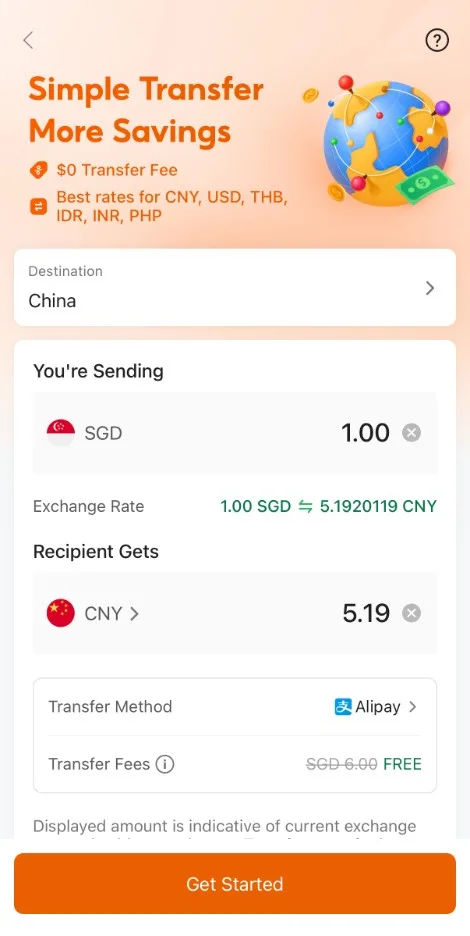
The quote I captured. Not a live rate. 3. Transfer information: China, CNY, Individual
The next screen asked for destination China, currency CNY, and recipient type Individual, then Next. That is the flow I opened. I did not complete a transfer.
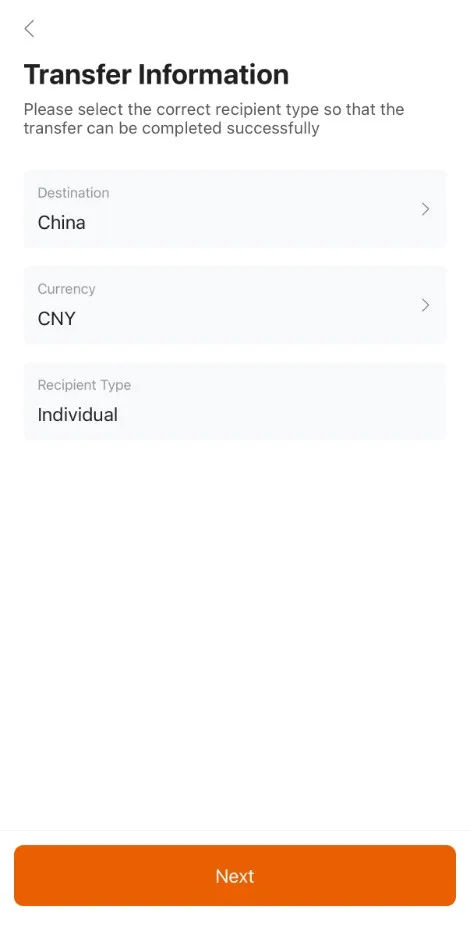
Recipient type on this screen was Individual. 4. Open the transfer limit before you promise a supplier a date
The in-app Transfer Limit note said the caps below are from all overseas senders, per recipient. Alipay per year: CNY 800,000 for Savings (to self only) or Family Support (to close relatives), CNY 600,000 for Payment for Goods, CNY 300,000 for Payment for Service. Weixin Pay per year: CNY 800,000 for savings or family support, or CNY 300,000 when paying out to the Weixin balance instead of a linked bank card. UnionPay: USD 10,000 per day and USD 50,000 per year. MariBank's payment-rail limits page lists the same annual figures, plus per-transfer caps.
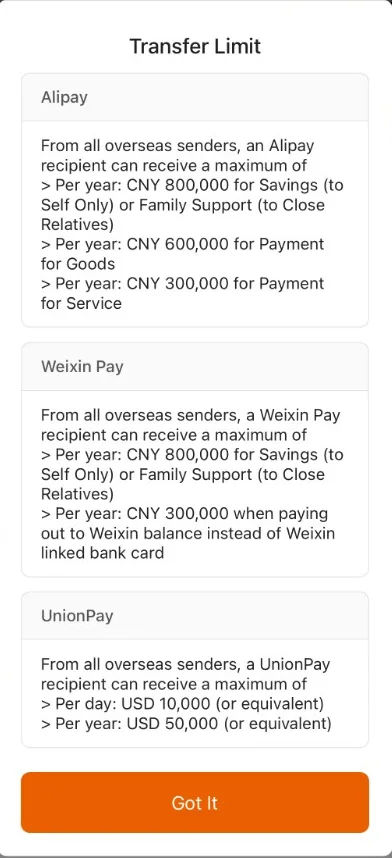
Limits shown in the app on 30 Oct 2026. 5. If the recipient uses WeChat, they have a step too
The app told me to remind the recipient to open WeChat, search the mini program “跨境汇款 微汇款”, and activate “我要收款”. That prompt is for Weixin. Alipay is a different switch: MariBank's transfer-method page says the Alipay wallet needs “跨境闪速收款” turned on.
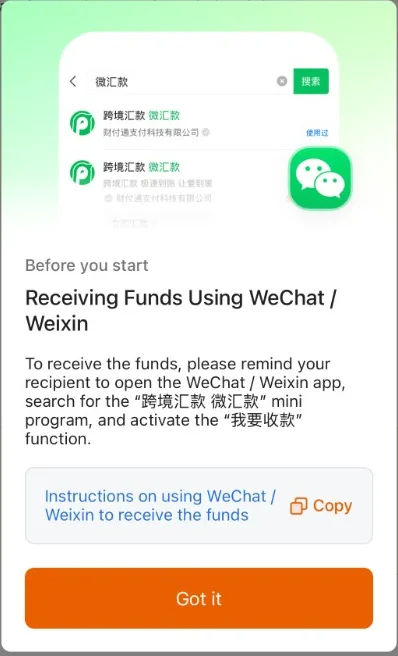
What the app showed for a WeChat recipient.
How to Pay Your China Carpentry Supplier from Singapore
This is the order I would use. It is not a MariBank receipt. I paid Jishang on the Hanshan rate, and I stopped at the quote screens above.
- Confirm the RMB amount. Get the figure in RMB from the supplier, including what is deposit and what is the balance. Do not convert their yuan into “about S$…” in your head and then send that.
- Check the rate. Open the app or the Hanshan page the morning you pay. The 30 Oct numbers on this page are a reference, not the rate waiting for you.
- Compare providers. Drop the amount into the calculator. Look at RMB received, not only at a $0 fee badge.
- Check limits and fees. A carpentry deposit can clear the per-transfer cap even when the yearly goods cap still has room. Split it if the app says so, and read the fee line in case the waiver has ended.
- Confirm the receiving method. Ask the supplier whether they want Alipay, Weixin Pay, a UnionPay card, or a company bank account. Then match that to a method MariBank actually supports for that kind of recipient.
- Account for intermediary and receiving fees. MariBank's method page says the recipient's bank may charge an extra fee on an incoming wire. I do not have a number for what Alipay or Weixin keeps on their side. Ask the supplier what landed last time, or what they expect to land this time.
- Verify the final RMB. Read the recipient-gets figure in the app before you confirm. The S$1 screen I captured showed 5.19 CNY on the big number and 5.1920119 in the rate line. Use the full quote, not the rounded preview.
Verify the bank details directly with the supplier, on a number or chat you already know is theirs. Beware of changed payment details. If a new account number shows up in a message, do not pay it until you have confirmed it with them. I would rather delay a deposit than fund the wrong account.
FAQ
What is today's MariBank SGD to RMB exchange rate?
This page is not a live rate. On 30 Oct 2026 at 10:25am SGT, the MariBank app quoted 1.00 SGD = 5.1920119 CNY for a transfer to China via Alipay. The same screen said the displayed amount is indicative. Check the app when you actually send. The rates here are labelled reference rates captured 30 Oct 2026, not live.
Is MariBank good for SGD to RMB conversion?
On that morning the MariBank quote was stronger than the Hanshan indicative TT rate of 1 SGD = 5.170 RMB, which I checked at 10:19am. A stronger rate only helps if your supplier can receive the funds and the transfer fits the limits. I have not used MariBank to pay a supplier. I paid Jishang Furniture using the Hanshan rate. Judge it on the receiving method, the caps, and the rate on the day you pay.
How do I check the MariBank SGD to RMB rate?
In the MariBank app on 30 Oct 2026 I opened the Transfer tab and tapped Overseas Transfers, which was tagged $0 Fee. The amount screen let me set China as the destination and showed the SGD to CNY rate before Get Started. MariBank's overseas transfer page also says to tap Overseas Transfers from the Mari Savings Account homepage, so follow the path your app shows and read the rate before you confirm. I check Hanshan the same morning at hanshanmoney.com. Their TT table is indicative too.
What is the difference between RMB and CNY?
Same currency. CNY is the currency code. RMB means renminbi, the name of that currency. Bank screens flip between the two. If a screen says CNY, it is RMB.
Is SGD to yuan the same as SGD to RMB?
Yes, in normal use. Yuan is the unit of the renminbi. When a China supplier says pay in yuan, they mean RMB / CNY. It is not a second currency next to RMB.
How much is S$1,000 in yuan?
At the 30 Oct 2026 reference rates, S$1,000 was about RMB 5,192 at MariBank and about RMB 5,170 at Hanshan, before any fee. MariBank's quote was 1 SGD = 5.1920119 CNY. Hanshan's indicative TT rate was 1 SGD = 5.170 RMB. I use S$1,000 because one Alipay or Weixin Pay transfer is capped at CNY 50,000, so a much larger sum would not go in a single transfer. Those are captured rates, not a live conversion.
What is the cheapest way to transfer SGD to RMB?
I only compared MariBank and Hanshan, so I am not calling either the cheapest in the market. On these reference rates, with the fee at zero, MariBank's 5.1920119 put more RMB on S$1,000 than Hanshan's 5.170 — about RMB 22 more, roughly S$4 at the MariBank rate. S$1,000 stays inside the CNY 50,000 per-transfer cap. The app struck through an SGD 6.00 Alipay fee and marked it FREE. MariBank's fee table still lists S$6 for Alipay to China, S$5 for Weixin Pay, and S$3 plus 0.60% for UnionPay, and says those transfer fees are waived under the $0 promotion through 31 Dec 2026 for Mari Savings Account customers. A waived fee does not help if the rate is worse, and I have no figure for what the recipient's bank or wallet might still deduct. Compare the RMB on the day you pay. I did not check Wise, YouTrip, or a bank-branch rate.
Can MariBank pay a China carpentry supplier?
Maybe. I have not done it. The flow I opened was for an individual recipient: destination China, currency CNY, recipient type Individual. MariBank's China limits page includes an Alipay purpose called Payment for Goods, capped at CNY 600,000 a year to the same recipient from all overseas senders, and Payment for Service at CNY 300,000 a year. A business account is a different rail. Their limits table lists China (B2B) as a CNY wire, up to SGD 200,000 or equivalent per transfer, and it can take longer if documents are needed. Business recipients may differ, so confirm with the supplier and with MariBank before you send a deposit. My own Jishang payment went out on the Hanshan rate.
How does MariBank compare with Hanshan for SGD to RMB?
On 30 Oct 2026, for S$1,000 and no fee, MariBank's reference quote was about RMB 5,192 and Hanshan's indicative TT quote was RMB 5,170. MariBank was ahead by about RMB 22, which is about S$4 at the MariBank rate. S$1,000 fits in one transfer. Alipay and Weixin Pay are each capped at CNY 50,000 per transfer, so a bigger carpentry payment has to be split. They are not the same product. Hanshan published an indicative telegraphic-transfer rate. MariBank showed an in-app Alipay quote, with the transfer fee marked free on that screen. I paid Jishang Furniture using the Hanshan rate. I have not sent a supplier payment through MariBank.
How do I save on the SGD to RMB rate for China carpentry?
Check the rates the morning you pay, put your SGD amount and any fee into the calculator, and look at the RMB gap in dollars. On a carpentry bill the rate matters more than a small fixed fee. The 5.20 versus 5.10 table on this page is illustrative, not a quote. Stay inside the recipient's yearly cap. If one transfer is capped — MariBank lists CNY 50,000 per Alipay transfer — split it and read the rate again. Get the receiving details from the supplier on a channel you already trust. If the account details change in a chat message, stop and confirm them directly.
Compare Before You Convert: Get More Value for Your China Carpentry Budget
The rate on the morning you pay is the one that changes the RMB. I used Hanshan for Jishang. MariBank's quote on 30 Oct was better than Hanshan's indicative rate that same morning, and I am sharing it so you can check yours — not because I have a MariBank receipt for carpentry. Run the amount, then confirm the account with your supplier.
Calculate Your SGD to RMB Conversion